
The Legend Lives On
by Seth Warburton
My children don’t like my music (their taste is questionable), so the sound is usually pretty low in the car. But some songs need to be appreciated at high volume. When I heard that opening guitar (srrriiing, bre-ing, breh bre-ang be-ang, buh sraang swidle-ang doo-swah-ung, etc.), I turned it up and told the offspring to can the complaining. Gordon Lightfoot sings “The legend lives on…” and the Edmund Fitzgerald sails onto stormy Lake Superior. The drums, like waves beating against the steel hull, come in just as the wind and waves increasing their intensity. By the time the church bell rings its twenty-nine chimes, the synthesizer is adding a paranormal sparkle and I’m too transported to hear the howls from the back seat. Fifty years after the sinking and the song that immortalized it, let’s read about shipwrecks.
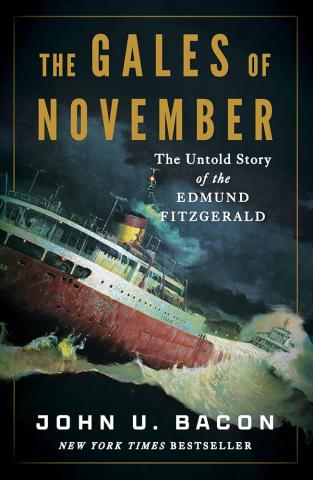
Author John U. Bacon began his career writing about sports, but had already branched into history before tackling the story of the Edmund Fitzgerald in “The Gales of November.” Even as familiar as the central story already seemed to me, this book is remarkable for its success in placing the wreck into context. First is economics, the steel and manufacturing boom that raised huge cities (and huge profits) all around the Great Lakes. Other expected topics feature too: ships and ship-building, lessons from earlier disasters, the men of the crew, their roles aboard. But most unexpected and interesting is the social context. There are portraits of the bars the sailors haunted in port; we meet the friends and families of the crewmen, lives which continued after the wreck; there are the searchers who tried to help, the newsmen who tried to make sense of the loss, and there’s the song which kept the story alive. And if that doesn’t sink your boat, try one of these others.
“A Marriage at Sea” by Sophie Elmhirst: A married couple survive a shipwreck and months in a life-raft. But survival becomes classical tragedy as life after rescue proves its own challenge.
“Captain’s Dinner” by Adam Cohen: One for true crime or legal drama readers. The ship goes down, the food runs out and a cabin boy seems to be dying already. What’s a hungry captain to do?
“A History of the World in Twelve Shipwrecks” by David Gibbins: Trust a novelist to imbue archaeological investigations with the excitement of an adventure narrative.